
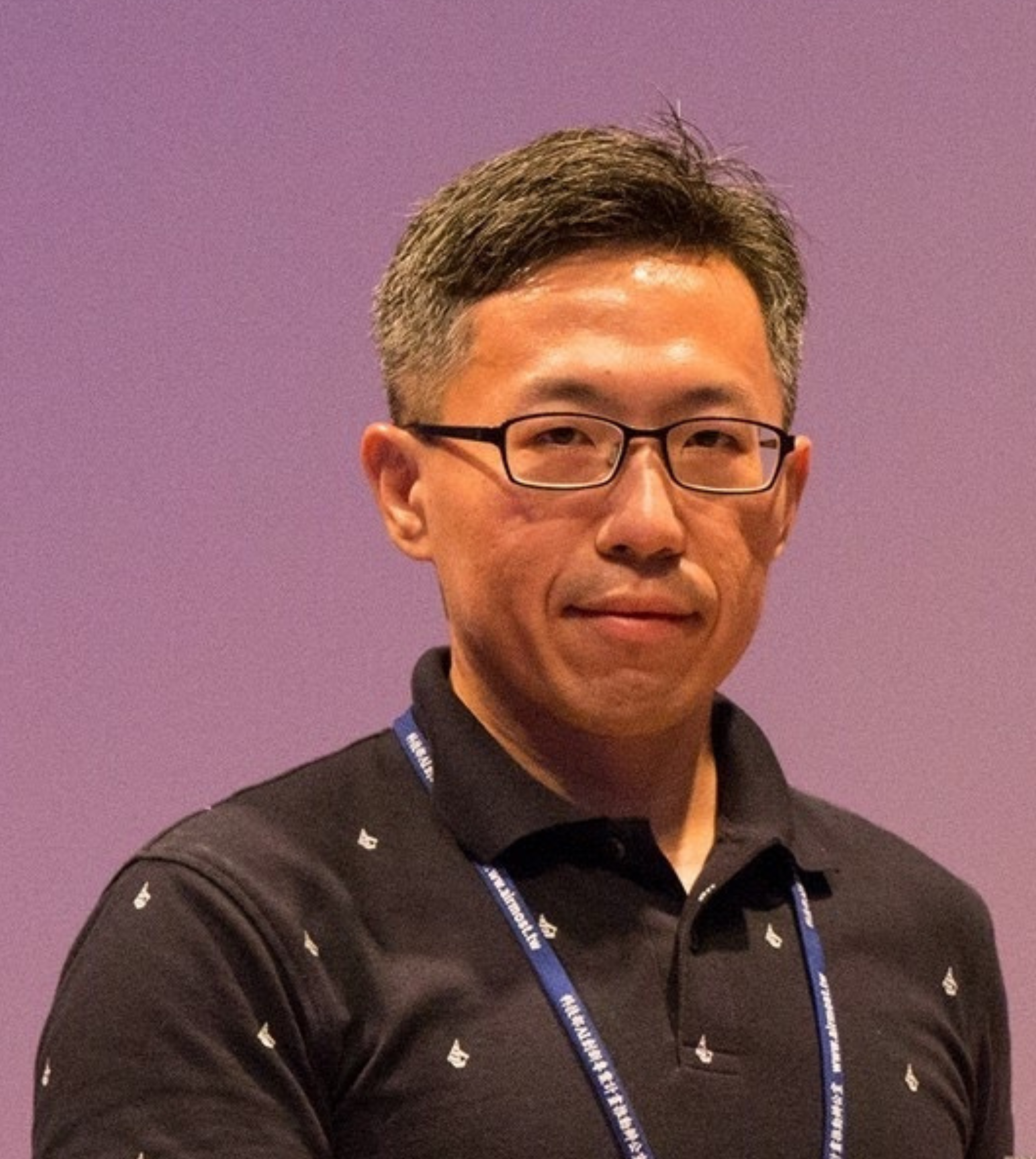
I am an Assistant Professor at the Center for General Education, National Central University in Taiwan. On this webpage, you can find more information about my projects, research, publications, teaching, former students, and other things.
Journal Papers published
Conference Papers published
Citations (h-index 5)
Funded project PI/Co-PI
Funded project NSTC/MOE/MND/NCU
Current graduate students
Current under graduate students
Best paper/poster awards
Publications this year
Student with awards
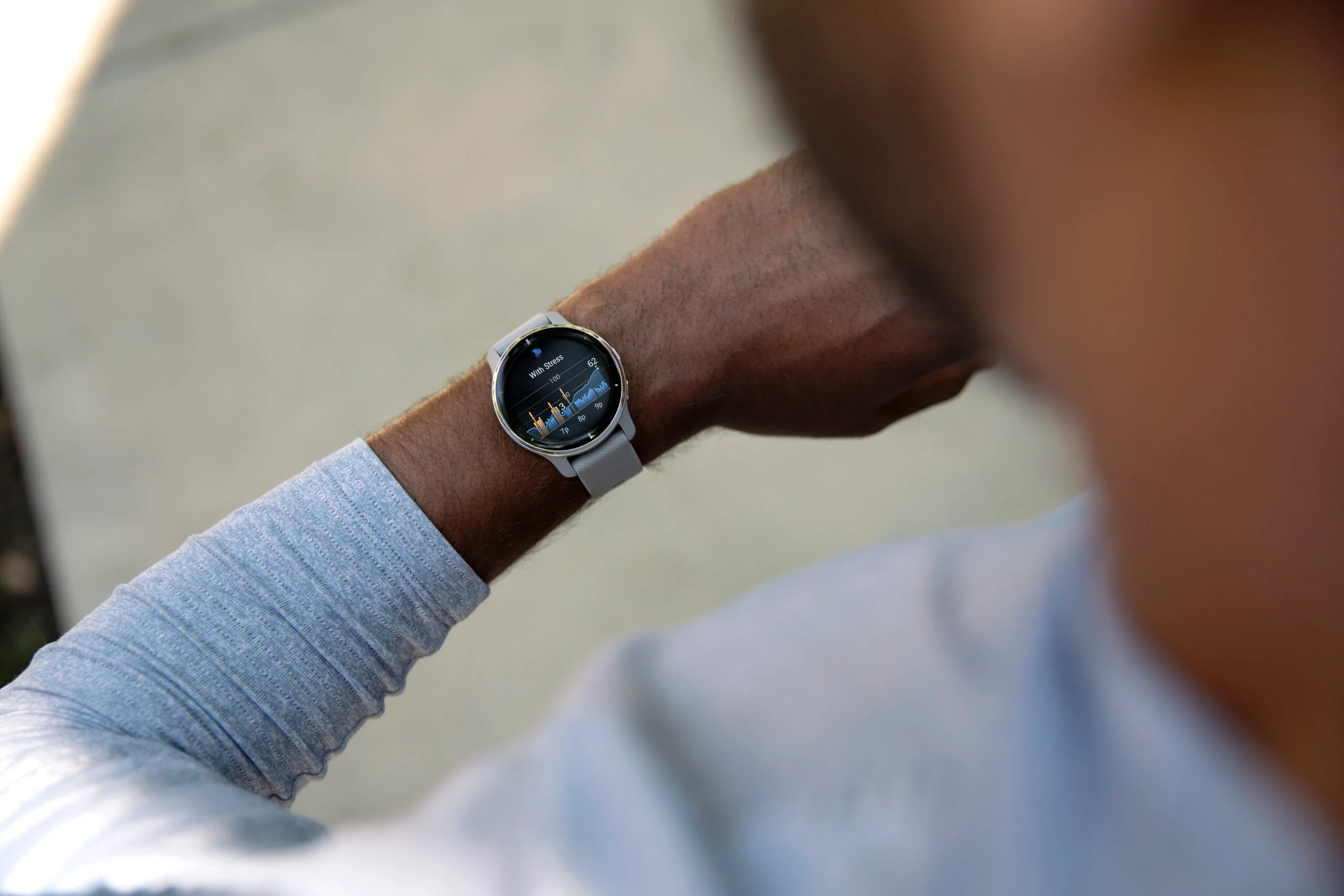
Researchers at NCU created the MindFit app to help improve mental health and well-being. The app uses an AI model to predict emotions based on HRV data collected by Garmin smartwatches and personal mood journal entries.
Read more..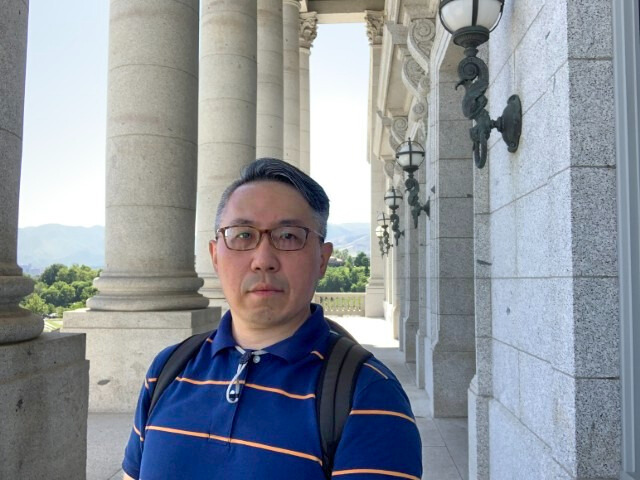
Chia-Kai Chang received his Ph.D. from the Graduate Institute of Photonics and Optoelectronics at National Taiwan University in 2018. In 2021, he joined the Center for General Education at National Central University as an Assistant Professor. There, he took the lead in designing and coordinating the interdisciplinary credit program on Artificial Intelligence Applications, reflecting his commitment to integrating AI literacy across diverse academic domains. His research spans digital learning, educational big data, wearable IoT technologies, and the development of functional near-infrared spectroscopy (fNIRS) systems. His projects are supported by multiple governmental agencies, including the National Science and Technology Council (NSTC), the Ministry of Education (MOE), the Ministry of National Defense (MND), and National Central University (NCU), underscoring the national relevance and cross-disciplinary impact of his work.
View Full Details CVEach pillar drives the data collection and analysis for the Educational Omics dimensions above
Omics: Cognitive, Linguistic, Social, Ethical
Skills: Python, JavaScript, AI/ML, Statistics, Data Visualization
Projects: Uedu platform, GenAI tools, Learning Analytics, MMLA
Omics: PhysioNeur
Skills: Signal Processing, Embedded Systems, Biomedical Engineering
Projects: fNIRS Brain Imaging, EEG Systems, Physiological Signal Acquisition
Omics: Environmental
Skills: IoT, Sensors, Embedded Systems, UAV
Projects: Drones, Environmental Monitoring, Wearable Devices, Unmanned Vehicles
Designing scalable architectures to collect, integrate, and analyze multimodal learning traces. This research aims to build trusted data lakes that support learning analytics, enabling personalized feedback and policy-driven improvements in education.
Current students: Amr ElSayed, Abdullah Maruf, Rofiqul Islam, Rokin Maharjan, Md Rahaman
Past students: Dipta Das, Vincent Bushong, Jan Svacina
Designing scalable architectures to collect, integrate, and analyze multimodal learning traces. This research aims to build trusted data lakes that support learning analytics, enabling personalized feedback and policy-driven improvements in education.
Exploring the use of generative AI to support semi-automated courseware creation, including quiz generation, concept mapping, and adaptive prompts. The goal is to reduce instructional workload while enhancing learner engagement and customization.
Students: Vincent Bushong, Amr ElSayed
Exploring the use of generative AI to support semi-automated courseware creation, including quiz generation, concept mapping, and adaptive prompts. The goal is to reduce instructional workload while enhancing learner engagement and customization.
Creating innovative digital platforms and learning scaffolds, such as virtual teaching assistants and multimodal feedback systems, to support student-centered learning in diverse classroom settings.
Current and formal students: Michal Trnka, Filip Rysavy, Vladyslav Gorbunov
Creating innovative digital platforms and learning scaffolds, such as virtual teaching assistants and multimodal feedback systems, to support student-centered learning in diverse classroom settings.
Designing and prototyping functional near-infrared spectroscopy (fNIRS) instruments for real-time, non-invasive monitoring of cerebral hemodynamics. Applications include learning cognition research and emotional state detection in educational settings.
Current students: Micah Schiewe, Jacob Curtis, Amr ElSayed
Current Bachelor students: Andrew Walker, Ian Laird, Jan Svacina, Jonathan Simmons, Dipta Das, Denton Woods
Designing and prototyping functional near-infrared spectroscopy (fNIRS) instruments for real-time, non-invasive monitoring of cerebral hemodynamics. Applications include learning cognition research and emotional state detection in educational settings.
Developing APIs and data pipelines to interface with wearable devices such as smartwatches. This work supports the collection and interpretation of physiological data to inform health-aware, personalized learning experiences.
Students:Ernesto Caballero
Developing APIs and data pipelines to interface with wearable devices such as smartwatches. This work supports the collection and interpretation of physiological data to inform health-aware, personalized learning experiences.
Integrating physiological signals, behavioral data, environmental context, and language interactions to form an educational “omics” framework. This research supports multimodal learning analytics (MMLA) for real-time learner modeling and adaptive educational interventions.
Current and formal students: Micah Schiewe, Jacob Curtis, Md Rahaman, Andrew Walker, Dipta Das, Michal Trnka, Filip Sedlinsky
Integrating physiological signals, behavioral data, environmental context, and language interactions to form an educational “omics” framework. This research supports multimodal learning analytics (MMLA) for real-time learner modeling and adaptive educational interventions.
Developing unmanned aerial vehicle (UAV) systems for collecting environmental data in educational settings. This project integrates drone technology with IoT sensors to capture temperature, humidity, air quality, and other environmental variables that affect learning conditions.
Focus: UAV systems, Environmental sensing, Data collection automation
Current students: Recruiting
Developing unmanned aerial vehicle (UAV) systems for collecting environmental data in educational settings. This project integrates drone technology with IoT sensors to capture environmental variables that affect learning conditions.
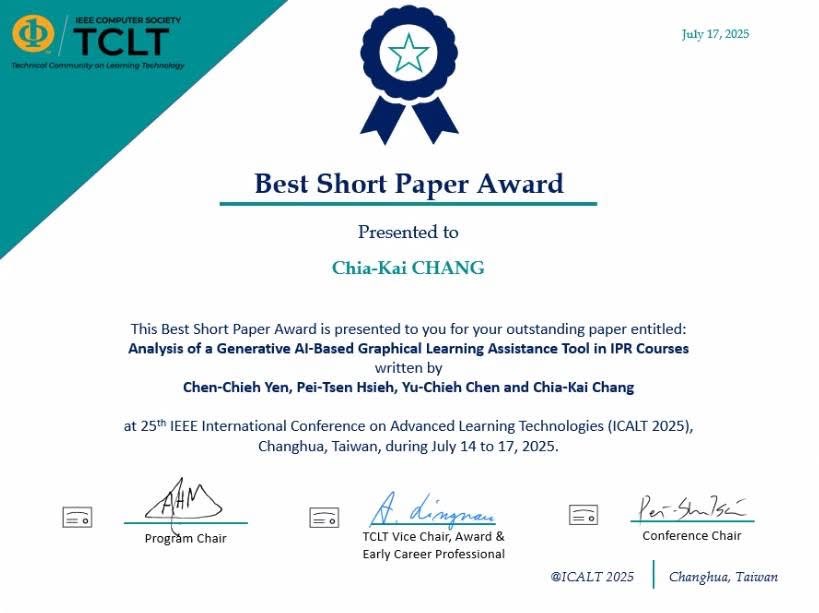
at 2025 IEEE International Conference on Advanced Learning Technologies (ICALT) for
Analysis of a Generative AI-Based Graphical Learning Assistance Tool in IPR Courses
by C.-C. Yen, P.-T. Hsieh, Y.-C. Chen and Chia-Kai Chang
Spring/Fall
Spring/Fall/Summar
Spring/Fall
Summar
Spring/Fall